




By Tana Malinga
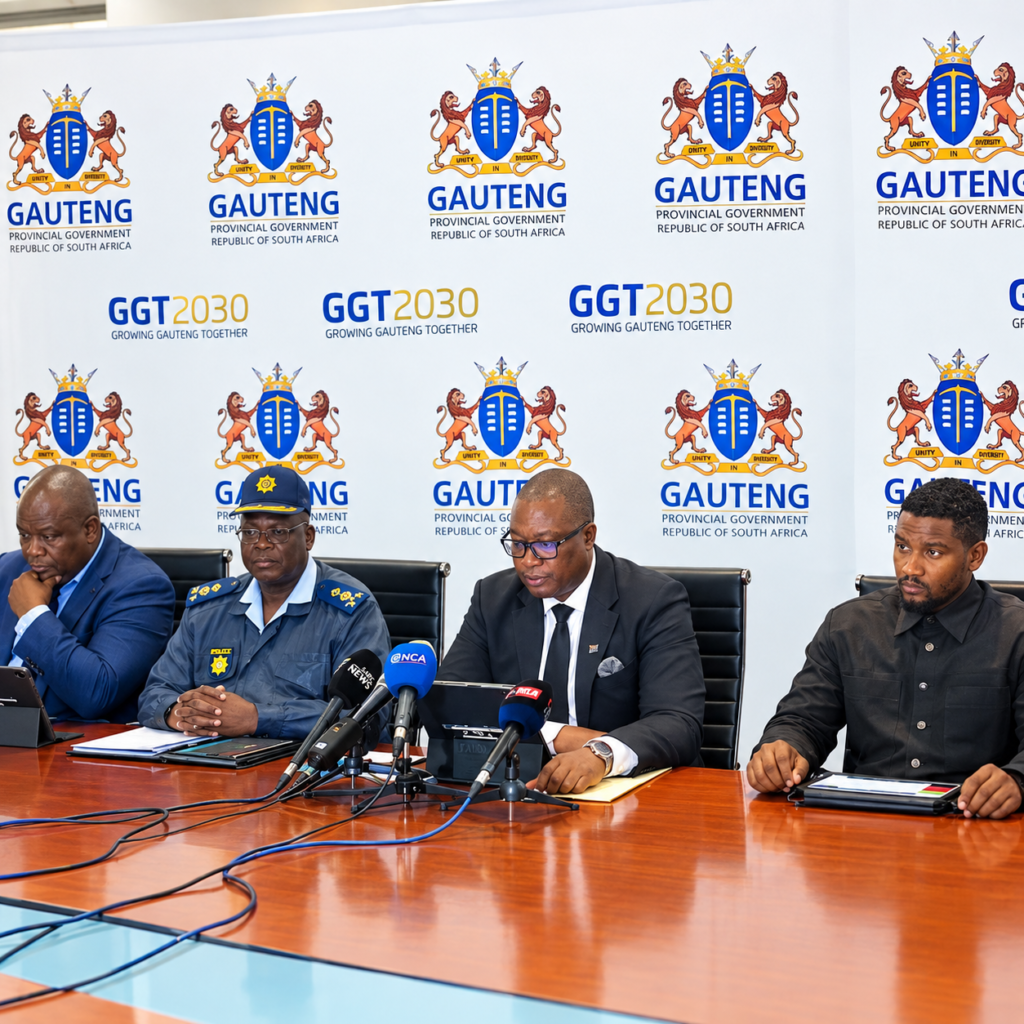
Gauteng is showing signs of progress across infrastructure, investment, healthcare, education, governance and local government, but Premier Panyaza Lesufi says the gains must be measured against persistent challenges, including water disruptions, violence, public safety and growing informal settlements.
Building a province that works
More than R2 billion has been invested in social infrastructure during the current financial year, with about 24 new and delayed projects creating temporary jobs and opportunities for township SMMEs. Five long-delayed schools have been completed: Bantubonke ECD Centre, Rust-ter-Vaal Secondary School, Dr W.K. du Plessis LSEN School, Nancefield Primary School and Simunye Primary School.
Construction continues at Semphato Junior Secondary School, Bekkersdal Social Integrated Facility, Johannesburg Forensic Pathology Lab and the Women’s Living Monument in Tshwane, while 26 rehabilitation, renovation and refurbishment projects include Thubelihle Intermediate, St Ansgar’s Combined and Laerskool Generaal Nicolaas Smit.
The Department of Infrastructure Development says its new turnaround strategy is helping ensure new-generation projects are delivered on time and within budget.The province has also advanced the appointment of a new Gautrain concessionaire, with negotiations concluded and National Treasury approvals secured for financial close. Operations under the new concessionaire are scheduled to begin 28 September 2026, bringing planned longer operating hours, expanded taxi feeder routes, station upgrades, additional trainsets and renewable energy investment.
Investment, jobs and economic opportunity
The April Gauteng Investment Conference secured R200 billion in new private investment pledges, taking the province’s two-year total to more than R500 billion.
Since June, Market Access Expansion Workshops have helped entrepreneurs and SMMEs meet standards required by major retailers. The Automotive Learning Centre was relaunched in July as a Manufacturing Centre of Excellence, providing training in robotics, artificial intelligence and electric-vehicle technologies.The Local Economic Development Strategy Assessment Workshop and the 4th Gauteng Women in Business Conference have focused on stronger municipal economic plans and improved market, finance and contract access for women-owned businesses.
The objective, Lesufi said, is ultimately to turn investment and economic growth into jobs, opportunity and better livelihoods.
Local government and financial responsibility
Despite isolated water challenges, the province reports progress in restoring water systems and improving electricity distribution. Through CoGTA and e-Government, Smart City initiatives including the e-Indigent Register, Water Solutions Dashboard, Local Government Turnaround Barometer, Disaster Management Information and Communications System and Gauteng@YourService are being used to improve municipal efficiency, decision-making and service delivery.
Council stability has been maintained across all 11 municipalities, with functional Financial Misconduct Boards in place. Unauthorised, irregular, fruitless and wasteful expenditure has declined, while targeted support is being provided to improve future audit outcomes.
Mogale City has strengthened its financial position, Midvaal continues to perform well, and 96% of the Municipal Infrastructure Grant had been spent by the end of June 2026.
Residents are also urged not to build on or near critical infrastructure servitudes, where illegal developments increase costs and expose communities to serious risks.
On e-tolls, Gauteng has paid R13.9 billion of R20.086 billion owed for e-toll-related debt and Gauteng Freeway Improvement Project maintenance obligations. Following the June payment, approximately R6.17 billion remains. The province says it continues prioritising healthcare and education while investing in infrastructure.
North West Transport Investment bus services have also begun a phased return in Hammanskraal and surrounding areas after progress in operational planning, employee engagement, security, fleet readiness, ticketing and subcontractor coordination. Thousands of commuters have regained access, with services expected to increase towards full operations.
Water security remains urgent
The GCR Water Security Response Plan, involving CoGTA, the IGR Water Forum, Provincial Water Response War Room, Department of Water and Sanitation, Rand Water, SALGA, DBSA and municipalities, is being implemented to stabilise supply and rebuild resilience.Measures include weekly coordination, hotspot tankering, emergency leak repairs and pipe replacement, pressure management, restrictions and illegal-connection removal.Recent power failures caused major shortages in Johannesburg, the West Rand and Rustenburg. A Fordsburg substation fault on 7 September and an Eskom power-line failure on 13 September disrupted Rand Water pumping stations. Although electricity was restored quickly, depleted reservoirs take days to recover because consumption exceeds pumping capacity.
City Power and Eskom are upgrading substations, adding backup equipment and specialist teams to protect power lines. Rand Water is investing in alternative power sources, while government and utilities will meet weekly to monitor progress, coordinate tankers and encourage water conservation.
A cleaner, greener Gauteng
Gauteng has strengthened its environmental standing nationally and internationally after securing the Vice-Presidency for Africa of Regions 4, creating opportunities to pursue climate finance, investment and partnerships.The province conducted 310 environmental inspections and is pursuing 117 enforcement actions against non-compliant waste facilities, pollution and illegal dumping.
Through Bontle ke Botho, almost 200,000 trees were planted against a target of 100,000. Environmental programmes created 2,631 work opportunities and supported 466 full-time-equivalent EPWP jobs.
Yet the province acknowledges the need to improve municipal waste management, accelerate the circular economy, strengthen air-quality interventions, rehabilitate problematic waste sites and convert environmental action into cleaner communities, jobs and economic opportunities.
Education: placement, examinations and subsidies
The 2027 Online Admissions application period closed on 4 September 2026, with 805,688 applications for Grades 1 and 8 and 357,468 parents and guardians registered.
The system recorded 169,396 unique Grade 1 learners and 177,481 unique Grade 8 learners, totalling 346,877 individual learners seeking placement. The Department is now processing applications and working to place learners fairly while managing pressure at high-demand schools.
Gauteng is also prepared for the 2026 NSC examinations, with examination centres, personnel, systems and security measures in place. Educators, school management teams, examination officials, security agencies, parents and learners have been commended for their preparation.
On subsidies, the province had planned the first 50% tranche of R2.6 billion for May. Although Gauteng correctly projected its requirements, the national cash allocation to provinces was calculated on a monthly straight-line basis, creating a shortfall. The issue was raised jointly by all ten education departments and ten treasuries.
To date, R1.7 billion has been paid, with R900 million outstanding. For public ordinary and special schools, the outstanding R900 million is planned for September and October, subject to monthly Treasury cash allocations. For independent subsidised schools, two tranches representing 50% have been paid; the November and January tranches will be paid according to policy and subject to cash availability.
Health: 24,390 Lenacapavir initiations
Gauteng began the phased rollout of Lenacapavir in June across five districts and 133 healthcare facilities as part of the national HIV prevention strategy.
The twice-yearly injection can reduce the risk of HIV acquisition when used alongside safer-sex practices.
Between June and August, 24,390 new initiations were recorded. Johannesburg leads with 9,723 initiations, while Sedibeng recorded 136% performance in July and currently leads August performance at 56%.
Governance: accountability and consequence management
Gauteng continues lifestyle audits targeting officials responsible for Supply Chain Management and Finance across provincial departments. 3,671 officials have submitted forms, while reports for the Office of the Premier and Gauteng CoGTA have been finalised.
The Premier has requested SIU forensic investigations into 20 officials, 14 from the Office of the Premier, eight high-risk and six medium-risk and six from CoGTA, two high-risk and four medium-risk.
The SIU has also begun lifestyle audits of Health SCM and Finance officials, with Tembisa Hospital the first focus.
Lifestyle audits were requested for three new HODs in Agriculture; Sport, Arts, Culture and Recreation; and Roads and Transport. The State Security Agency is finalising vetting and lifestyle audits of MECs for e-Government, Environment, and Roads and Transport. Lifestyle audits of all CEOs and HODs have been concluded.
The province has recovered the full R7,246,127.43 advanced to Nonkwelo Investments (Pty) Ltd, following a court-mediated settlement concluded in November 2025, safeguarding the public funds involved.Audit outcomes reveal both progress and unfinished work
For 2025/26, five departments, Office of the Premier, Treasury, e-Government, CoGTA and Community Safety sustained clean audits with no findings.
Nine departments received unqualified opinions with findings. Five sustained their previous outcomes, while Economic Development and Transport regressed from clean to unqualified. Environment recorded an unqualified opinion as a new department, while Sport, Arts, Culture and Recreation improved from a qualification.
The results point to areas of sustained performance alongside a continuing need for stronger controls and accountability.
Kopanong: R558 million irregular expenditure
A forensic investigation into the Kopanong Precinct Project found serious weaknesses in the management of leases used to accommodate nine provincial departments while government-owned buildings remained vacant.
Findings included the absence of proper procurement or approved deviations, weak contract management, automatic lease renewals, repeated month-to-month extensions and failures to comply with approval requirements.
The investigation identified R558,079,624.71 in irregular expenditure and recommended that Infrastructure Development reassess its leasing strategy, particularly in light of delays to the Kopanong Precinct Project.
The Premier has committed to implementing the recommendations as a priority.
More investigations, stronger consequence management
The province is implementing recommendations from SIU, forensic and Public Protector investigations.
In the Farmyard Project investigation at Agriculture and Rural Development, the SIU recommended disciplinary action against 10 current and former officials, criminal referrals where appropriate and lifestyle audits. The Office of the Premier will support the disciplinary process through an Evidence Leader and Chairperson, while the SIU continues investigating grant allocation.
At Sport, Arts, Culture and Recreation, disciplinary proceedings will begin against four senior officials following a forensic investigation into recruitment irregularities.
Economic Development will implement recommendations from the Mega Hubs investigation, including disciplinary action, law-enforcement referrals and stronger project-management controls following findings of irregular, fruitless and wasteful expenditure.
The province has also committed to implementing Public Protector recommendations concerning spaza-shop food safety and delays in repairing Charlotte Maxeke Johannesburg Academic Hospital. A provincial task team is driving the food-safety response, while remedial work at Charlotte Maxeke is already underway.
Crime: progress, but a painful warning
The latest Gauteng crime statistics presented by SAPS Acting Provincial Commissioner Major General Fred Kekana show a 3% decline in contact crime during the first quarter of 2026/27, including reductions in murder, sexual offences and aggravated robbery.Operation Shanela has continued producing results through targeted arrests and the recovery of illegal firearms, drugs, stolen vehicles and counterfeit goods, while disrupting organised criminal activity.
The progress reflects coordinated work between law enforcement, government, communities, business and civil society. Gauteng Traffic Police, Metropolitan Police Departments, Business Against Crime South Africa, Community Police Forums and community volunteers were commended for their role.
Yet attempted murder and assault-related crimes have increased, reinforcing that violence remains a serious challenge.
Through the province’s Intergovernmental Relations approach and the Integrated Crime and Violence Prevention Strategy, government says it is strengthening cooperation across sectors, integrated policing and community-safety interventions.
Eight women. Eight lives. A province in mourning.
Against every statistic, every infrastructure project and every economic milestone stands the value of human life.
Premier Lesufi opened his update with profound sadness following the discovery of the bodies of eight women in separate incidents across Ekurhuleni—a development that has shaken Gauteng and again exposed the devastating human cost of violence against women.
The Gauteng Provincial Government extended its condolences to the families, loved ones and communities affected and reaffirmed that every woman has the right to live free from fear, violence and harm.
Government says it will continue supporting law-enforcement agencies investigating the deaths and pursuing those responsible.
The message from the province is therefore one of progress, but not complacency; accountability, but not yet completion; hope, but never at the cost of ignoring pain.
Gauteng is investing, building, reforming, expanding healthcare, supporting economic opportunity and strengthening its institutions. But the province’s unfinished work remains equally clear: safer communities, reliable water, stronger municipalities, cleaner governance and a Gauteng where women can live, work and move without fear.
The road ahead is demanding but the promise remains to build a province that is safer, more resilient, accountable and capable of delivering a better life for its people.