




Tana Malinga
Gauteng’s 2027 school admissions process has moved from the race to apply to an even bigger battle, placing learners where there is actual space.
The Gauteng Department of Education received a staggering 805 688 applications for Grade 1 and Grade 8 placements before the online admissions window closed at midnight on 4 September.
But the figure does not represent 805 688 individual learners.
According to Education MEC Lebogang Maile, 357 468 parents and guardians registered on the system, representing 346 877 individual learners , 169 396 Grade 1 learners and 177 481 Grade 8 learners. Parents are permitted to apply to more than one school, which explains the much higher application figure.
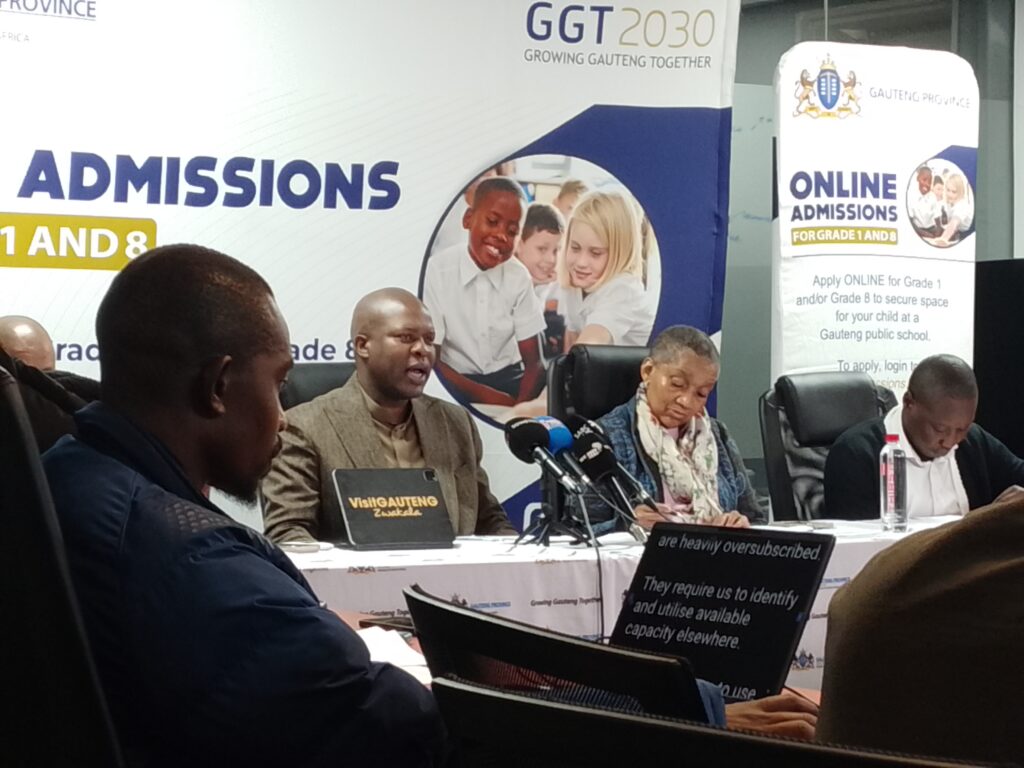
The numbers were revealed by Maile during his briefing on Sunday, 6 September, following the conclusion of the month-long application period.
And behind those statistics lies Gauteng’s bigger education dilemma: demand is increasingly concentrated at certain schools, while available capacity is unevenly distributed across the province.
Maile said the figures should be understood as more than admission statistics because they reveal where communities are growing and where pressure on public education is becoming most intense.
“These figures are more than admissions statistics. They tell us where families are settling, where communities are expanding, where parental demand is concentrated and where the public education system is experiencing the greatest pressure.”
THE NUMBERS TELL A MUCH BIGGER STORY
The province currently has about 405 627 available spaces, meaning the challenge is not simply about building more schools, but ensuring that existing capacity is distributed and utilised effectively.
Some schools have attracted extraordinary demand.
At Grade 8 level, Hoërskool Langenhoven in Tshwane West received 3 462 applications, followed by Alberton High School with 2 756 and Katlehong Secondary School with 2 747.
Katlehong Engineering School of Specialisation received 2 573 applications, while Parktown Boys’ High School received 2 448.
For Grade 1, Laerskool Akasia recorded 1 355 applications, followed by Palmridge Primary School with 1 330, Alston Primary School with 1 207, Lakeside Primary School with 1 162 and Stoneridge Primary School with 1 153.
For Maile, these figures expose a fundamental problem: Gauteng cannot continue expanding capacity only at schools that are already overwhelmed.
“We cannot sustain a situation where one public school is overwhelmed by thousands of applications while another public school, sometimes only a few kilometres away, has available classrooms or declining enrolment.”
The MEC argued that the province needs to rethink how existing school capacity is used rather than simply responding to demand by continually expanding the most popular schools.
THE PLACEMENT TEST NOW BEGINS
With applications closed, the pressure shifts to the department.
Applications must first undergo document verification before being sent to district offices for quality assurance. Placement decisions will take into account prescribed criteria, including the learner’s residential address, feeder zones, proximity, siblings already attending a school and other applicable factors.
Parents and guardians who still have outstanding documentation have until 12 noon on 11 September 2026 to submit or upload certified documents.
The department has placed particular emphasis on proof of home address, because residential location forms an important part of determining placement.
Applications without the required certified proof of address by the deadline, or applications supported by fraudulent or invalid documentation, will be regarded as incomplete and will not receive placement offers.
Parents are expected to start receiving placement offers from 15 October 2026, with seven days provided to accept or decline an offer.
THE REAL PROBLEM IS NOT ONLY THE ONLINE SYSTEM
The latest figures also expose a deeper challenge facing Gauteng.
The province’s population is growing, communities are changing and residential development is creating new concentrations of learners, sometimes faster than conventional school infrastructure can be planned and delivered.
Maile has therefore called for a rethink of the traditional model in which government finances, designs, procures and constructs every education facility through conventional processes.
Alternative approaches, including public-private partnerships, leasing, refurbishment, alternative construction technologies and temporary classrooms, are being considered as part of the response to capacity pressures.
However, Maile stressed that temporary or mobile classrooms cannot become a substitute for long-term infrastructure investment.
The central question is whether Gauteng can provide learners with safe, dignified and functional classrooms when they are actually needed.
MAILE’S BIGGER CHALLENGE: MAKE EVERY SCHOOL A SCHOOL OF CHOICE
Perhaps the most significant part of the MEC’s argument goes beyond admissions.
Gauteng cannot permanently solve its placement crisis if thousands of parents continue competing for a relatively small number of schools perceived to offer better education.
Maile has argued that the province must improve the quality of public education across the entire school network so that parents have confidence in schools closer to their homes.
“The long-term answer to admissions pressure cannot simply be to expand a small number of popular schools indefinitely. It must be to systematically improve quality across the entire public-school network so that parents have confidence in the school closest to where they live.”
That puts the spotlight not only on classrooms and infrastructure, but also on school leadership, educator performance, discipline, safety, learning materials, School Governing Bodies, management and accountability.
ADMISSIONS AS A PLANNING TOOL
Maile has also defended the online admissions system as more than a mechanism for allocating school places.
The data provides government with information about where children live, where communities are expanding and where demand for schools is likely to increase.
Earlier in the application cycle, Maile explained that without knowing how many children are coming into the system, government cannot properly determine how many teachers, desks, chairs, textbooks, workbooks or even schools will be required.
That makes the admissions database an important planning instrument — but only if government acts on the information it produces.
THE NEXT TEST FOR GAUTENG
The application period may be over, but for thousands of Gauteng families, the anxiety is only beginning.
The department now has to translate hundreds of thousands of applications into actual placements while balancing parental choices against available capacity.
The biggest question is no longer “Did the online system receive the applications?”
It is:
Can Gauteng place every learner fairly, safely and on time, without forcing parents into another annual battle for scarce school spaces?
The 805 688 applications have given government an unusually detailed map of where educational demand is concentrated.
The challenge now is whether that information will translate into more classrooms, better schools, smarter planning and, ultimately, a public school system where parents do not have to fight for access to quality education.
As Maile put it, the broader goal is to ensure that every child can access a school that is safe, properly resourced and capable of delivering quality education.