







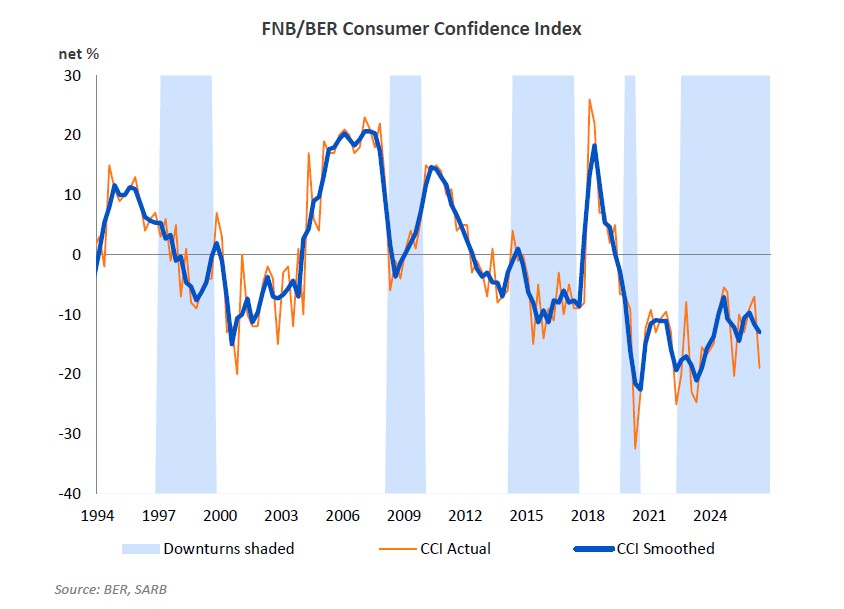
The FNB/BER Consumer Confidence Index (CCI) plunged from a 15-month high of -7 in the first quarter of 2026 to -19 in the second quarter.[1]
The latest CCI reading is the lowest since the first quarter of 2025 (-20) when the Finance Minister tabled his (aborted) proposal to hike VAT by two percentage points in the February 2025 budget speech. This time around, it is the fallout from the Iran war and the closure of the Strait of Hormuz that has driven consumer sentiment sharply lower – including soaring fuel prices, travel disruptions and lower stock prices on the JSE. Most of the second-quarter CCI survey fieldwork had been completed by the time the SARB announced a 25-basis-point interest rate hike, suggesting that tighter monetary policy may well dent consumer confidence further in the coming months.
Source: BER, SARB
Details
All three sub-indices of the CCI declined during the second quarter. The economic outlook sub-index of the CCI plunged from -14 to -32 index points, while the household finances index slumped from 12 to zero. Having already declined from -14 to -21 index points during the first quarter, the sub-index measuring the appropriateness of the present time to buy durable goods (e.g., vehicles, furniture, household appliances and electronic goods) retreated further to -24 in the second quarter. With higher fuel prices adding an estimated R45bn in costs to SA economy during the second quarter – significantly straining corporate and consumer budgets – it is not surprising that consumers have soured on the outlook for the national economy and their own household finances. The time-to-buy durable goods sub-index of the CCI declined by only 3 index points during the second quarter but could slump further in the third quarter once the impact of the May interest rate hike starts to weigh on disposable income. The risk for further tightening remains.
| 24Q1 | 24Q2 | 24Q3 | 24Q4 | 25Q1 | 25Q2 | 25Q3 | 25Q4 | 26Q1 | 26Q2 | ||
| Composite FNB/BER CCI | -15 | -10 | -5 | -6 | -20 | -10 | -13 | -9 | -7 | -19 | |
| Economic outlook | -22 | -9 | -7 | -9 | -32 | -18 | -22 | -19 | -14 | -32 | |
| Household financial outlook | 8 | 8 | 14 | 11 | -1 | 9 | 3 | 5 | 12 | 0 | |
| Suitability of the present time to buy durable goods | -30 | -28 | -23 | -21 | -28 | -21 | -20 | -14 | -21 | -24 |
Source: BER
Source: BER
A breakdown of the CCI by household income group shows that sentiment worsened the most among high-income consumers. The confidence levels of high-income households (those earning more than R20 000 per month) collapsed from -4 to -28 index points during 2026Q2, with the vast majority (53% net) of high-income consumers now expecting a deterioration in SA’s economic performance over the next twelve months (up from 13% net). High-income consumers also made a complete about-turn on their household finances, from a net majority of 14% expecting their household finances to improve, to a net 7% now expecting a deterioration in their financial position. The index measuring high-income households’ rating of the appropriateness of the present time to buy durable goods also deteriorated (from -15 to -23) in the second quarter.
The confidence levels of middle-income households (those earning between R5 000 and R20 000 per month) slumped from -7 to -19, while those of low-income consumers (those earning less than R5 000 per month) remained unchanged at -12.
FNB Chief Economist Mamello Matikinca-Ngwenya said, “With a large portion of high-income households making use of privately owned vehicles for transport, the household budgets of affluent consumers have been hard hit by the massive petrol and diesel price increases during the second quarter. Furthermore, the hike in the prime interest rate, soaring air fares and decline in stock prices on the JSE are all developments that disproportionately affect affluent households.” Petrol prices increased by 29% quarter-on-quarter (q-o-q) in the second quarter of 2026 (roughly R5.60 per litre), while diesel prices skyrocketed by 57% (R10 per litre). The JSE All Share Index is down roughly 12% from its February 2026 peak.
“In contrast, low-income households mainly rely on public transport, where bus and taxi fares have so far increased far less. Slowing food inflation has also shielded the spending power of less-affluent households to date. However, the adverse implications for low-income households are expected to mount once the impacts of higher fuel and fertiliser prices filter through the agriculture value chain to food inflation, as poor households spend a large portion of their budgets on food,” said Matikinca-Ngwenya.
Bottom line
The latest GDP data release shows that the growth in real consumer spending slowed from an impressive 3.9% y-o-y in 2025Q4 to (a still robust) 3.4% y-o-y in 2026Q1. However, in quarter-on-quarter (seasonally adjusted) terms, growth fell sharply from 1.2% in 2025Q4 to only 0.1% in 2026Q1. Matikinca-Ngwenya noted that “The alarming increase in transport costs and hike in the prime interest rate will seriously strain high- and middle-income households’ ability to spend, the income groups with the greatest purchasing power in the economy. The 12-point fall in consumer confidence signals that consumers’ willingness to spend also declined notably during the second quarter, with the latest CCI reading (-19) now being well below the long-run average of -1.”
This will likely translate into a contraction (in q-o-q terms) in real consumer spending during the second quarter of 2026, with discretionary spending expected to come under significant pressure. Indeed, results from the BER’s latest retail survey point to a marked deterioration in durable and semi-durable goods sales during 2026Q2.
On a more positive note, on 17 June the US and Iran signed a memorandum of understanding to end hostilities and start negotiations towards a final agreement. This welcome development sent oil prices tumbling to around $80 per barrel (from over $100 in May) – even with the fuel levy relief ending in July, SA is now on track for significant fuel price cuts in July. Although it will take many months for fuel prices to return to pre-war levels, and the interest rate cutting cycle may only resume next year, a deal to end the war in the Middle East – provided it holds – should relieve some of the pressure on the consumer towards the end of 2026.
Background
Consumer confidence surveys provide regular assessments of consumer attitudes and expectations and are used to evaluate economic trends and prospects. The surveys are designed to explore why changes in consumer expectations occur and how these changes influence consumer spending and saving decisions. The FNB/BER CCI combines the results of three questions posed to adults in South Africa, namely the expected performance of the economy, the expected financial position of households and the rating of the appropriateness of the present time to buy durable goods, such as furniture, appliances and electronic equipment.
Until the second quarter of 2019, the FNB/BER CCI was based on face-to-face interviews of between 2 000 and 2 500 urban adults. The BER switched to telephone call surveys in the third quarter of 2019. The 500 respondents are representative of the racial and household income composition of the urban adult population of South Africa. Internationally, the majority of CCIs are based on telephone call surveys.
Consumer confidence is expressed as a net balance. The net balance is derived as the percentage of respondents expecting an improvement / good time to buy durable goods less the percentage expecting a deterioration / bad time to buy durable goods.
A low level of confidence indicates that consumers are concerned about the future. They may be worried about job security, pay raises and bonuses. With such a frame of mind, consumers tend to cut spending to basic necessities (e.g. food and services) to free up income for debt repayment. If confidence is high, consumers tend to incur debt (or reduce savings) and increase spending on discretionary items, such as furniture, household equipment, motor vehicles, clothing and footwear. Some of these items are often financed on credit. Spending on these items declines when confidence is low, as households can generally delay their purchases without experiencing an immediate deterioration in living conditions.
A rise in consumer confidence reflects an increased willingness of consumers to spend. However, this willingness only translates into actual sales if consumers’ ability to spend improves. Their ability to spend depends on their inflation adjusted after-tax income and the availability of credit. A rise in consumer confidence could therefore result in an upturn in household consumption spending in general and retail and motor vehicle sales in particular. The opposite applies when the level of consumer confidence declines.
INFO SUPPLIED