




Tana Malinga
Gauteng’s education landscape is changing and independent schools are becoming an increasingly significant part of that story.
With 1 083 registered independent schools, 379 727 learners and almost 25 000 educators, the sector can no longer be viewed as a small alternative operating on the margins of public education.
But behind the impressive growth and strong academic results lies an important question, are parents, learners and communities sufficiently protected and informed when choosing an independent school?
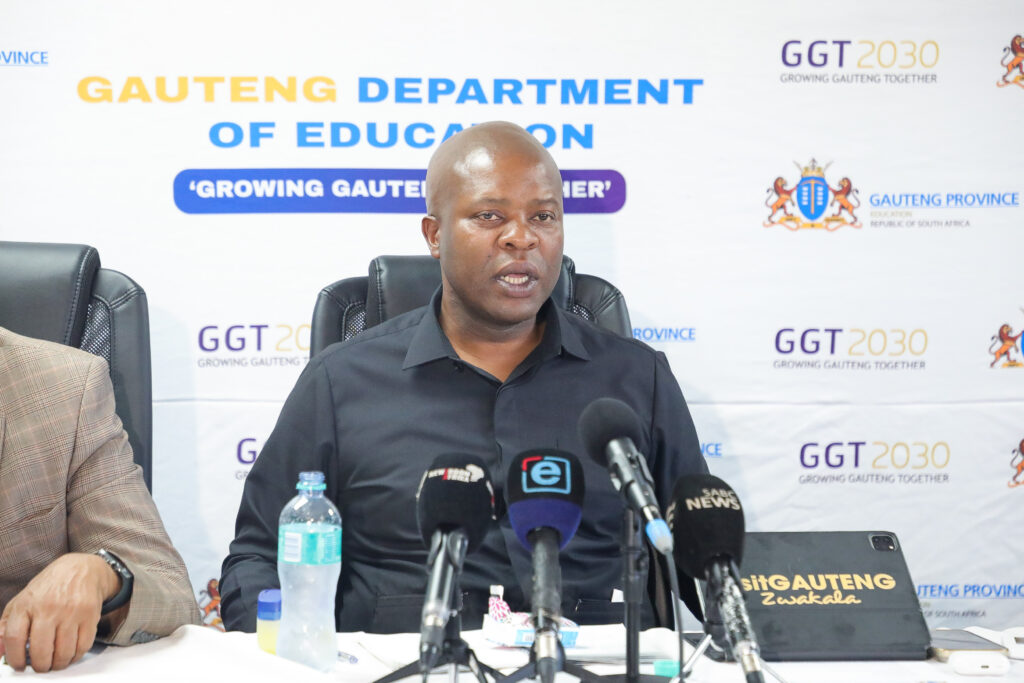
That is where the latest update from the Gauteng Department of Education becomes an eye-opener.
Over the past five years, the number of independent schools in Gauteng has grown from 961 in 2021 to 1 083 in 2026, an increase of 122 schools.
Johannesburg carries the largest share, with 557 schools serving 197 687 learners, followed by Ekurhuleni with 233 schools and 78 427 learners, Tshwane with 199 schools and 67 169 learners, Sedibeng with 59 schools and 15 206 learners, and the West Rand with 35 schools serving 6 350 learners.
The growth reflects a province where parents increasingly want choice.
But choice must come with quality, legality, accountability and protection.
Independent does not automatically mean better
Perhaps one of the most important messages emerging from the Department’s assessment is that the word independent should not automatically be associated with superior education.
Independent schools produced impressive results in the 2025 National Senior Certificate examinations.
Of the 12 291 independent-school learners included in the Department’s analysis, 11 651 passed, an overall 94.82% pass rate.
Even more encouraging, 127 schools achieved a 100% pass rate, while another 49 achieved between 95% and 99%.
In total, 176 schools, approximately 69% of those included in the analysis, achieved at least a 95% pass rate.
Mathematics recorded a 74.8% pass rate, Physical Sciences 83.6%, Accounting 88%, Life Sciences 91% and Business Studies 93.8%.
These results deserve recognition.
They also reinforce an important lesson: excellent education is possible when leadership, discipline, committed educators, learner support and a strong culture of teaching and learning come together.
That principle applies equally to public schools.
Gauteng’s public schools recorded an 89.06% NSC pass rate in 2025, with a 46% Bachelor pass rate. Many township schools continue to achieve remarkable results despite infrastructure pressures, overcrowding and difficult social circumstances.
The lesson is powerful: a school’s quality cannot be measured simply by whether it is public or independent.
The R1-billion-plus question
One of the most debated issues surrounding independent schools is government funding.
Why should taxpayers’ money support privately managed institutions?
The answer begins with the Constitution, which permits government to subsidise qualifying independent schools. The South African Schools Act provides the framework for such support.
Importantly, a subsidised independent school does not become a government school. It remains independently owned and managed.
Gauteng currently has 279 subsidised independent schools, while 804 receive no government operating subsidy.
Between the 2022/23 and 2025/26 financial years, approximately R4.3 billion was allocated to qualifying independent schools.
For 2026/27, the allocation is approximately R1.13 billion, with about R621 million directed towards primary education and R508 million towards secondary education.
That level of public investment naturally demands accountability.
The Department says it monitors financial planning, budgets, annual financial statements, banking and cash controls, payroll and assets.
By the end of Term 1 in 2026, 274 of the 279 subsidised schools had submitted annual financial statements.
Public money must follow public accountability and schools receiving support must be able to demonstrate how that money is managed.
Parents: check before you pay
For parents, perhaps the most practical message is simple:
Do not judge a school by its uniform, website, impressive building or advertisement. Verify it.
Before enrolling a child, parents should establish whether the school is properly registered with the Gauteng Department of Education.
Registration and Umalusi accreditation are not the same thing.
The Department’s registration gives an independent school legal authority to operate at its registered premises, while Umalusi accreditation relates to quality assurance for qualifications falling within its mandate.
Parents should ask to see the school’s EMIS registration certificate and confirm that the EMIS number and physical address correspond with the school their child will actually attend.
For families preparing a learner for matric, another critical question is: Which curriculum and examination body does the school use, and how will the learner be registered for the NSC?
Educators at independent schools must also be registered with the South African Council for Educators.
These may sound like administrative details, but they can prevent devastating consequences later.
When school fees become a battlefield
The Department received 3 688 cases concerning independent schools between 2024 and 6 August 2026.
Among the most common were registration matters, fee-related disputes, withholding of learner reports or transfer certificates, bullying and discipline, admissions and curriculum issues.
The numbers reveal something important: parents are concerned about far more than academic results.
They want to know whether their children are being treated fairly, whether the school is legitimate and whether their rights are protected.
A particularly important reminder concerns school fees.
The Department says an independent school may not suspend or expel a learner during an academic year, or withhold a learner’s progress report, because of contractual disputes between the parent and school.
That does not remove a parent’s responsibility to pay agreed fees.
It simply recognises a fundamental principle:
Adults may have financial disputes, but children should not become casualties of those disputes.
Illegal schools: an urgent warning
Perhaps the most concerning part of the update is the continued existence of illegally operating schools.
In 2025, the Department visited 57 suspected illegal schools and served 31 with letters.
Between January and September 2026, officials visited 61 schools and issued 32 closure letters.
Seven of those schools had ceased operating, four subsequently applied for registration and two school directors were arrested.
But closure cannot be the end of the story.
Every learner affected still needs a classroom, teachers and a legitimate educational pathway.
The Department therefore says districts must work with parents to ensure affected learners are placed in lawful schools.
This is where enforcement and compassion must meet.
Protecting the education system must never mean abandoning the child.
Special-needs education still needs a stronger spotlight
Gauteng has 36 independent schools serving learners with special education needs.
Yet only six receive government subsidies, while six education districts have no independent LSEN school at all.
This points to an uncomfortable reality: access to specialised education remains uneven.
For parents raising children who require additional educational support, availability, affordability and proximity can determine whether a child receives the support they need.
This is an area where continued collaboration between government, communities and education providers could restore hope to many families.
Home education is legal but it is not a loophole
Home education is another rapidly developing part of the education landscape.
The Department received 2 681 new home-education applications in 2026, with 1 892 approved at the time of the briefing and another 174 verified and awaiting approval.
Between 2022 and 2026, 6 930 learners were registered for home education in Gauteng.
Home education is lawful.
But the Department warns parents against confusing genuine home education with an unregistered school operating under labels such as a tutor centre, online school or homeschooling centre.
A parent may legally educate a child at home.
An institution enrolling groups of learners and functioning like a school cannot simply avoid registration by changing its name.
Migration, documentation and the child behind the number
Gauteng’s position as South Africa’s economic hub also means its schools serve learners from diverse backgrounds.
EMIS data records 45 789 learners in independent schools within migration-related citizenship categories.
Of these, 30 653 have verified documentation recorded on the system, while 15 136 do not have valid documentation reflected there.
But behind those numbers are children.
The Department notes that 17 714 learners in this group were born in South Africa to parents who hold foreign citizenship.
There are also 1 965 learners from this cohort currently in Grade 12.
Documentation problems therefore need to be addressed early, particularly because incomplete records can create difficulties when learners reach matric and require certification.
The focus should remain firmly on education administration and ensuring that children do not lose opportunities because problems were allowed to grow unchecked.
A history that still shapes today’s schools
Gauteng’s education challenges cannot be understood without acknowledging the country’s unequal past.
During apartheid, education spending was profoundly unequal. By the beginning of the 1990s, the apartheid government was spending R1 211 per White child compared with R146 per Black child in public schools.
The consequences did not disappear in 1994.
Some historically well-resourced schools entered democracy with established infrastructure, laboratories, libraries, sporting facilities and other resources, while many schools serving Black communities entered the new democratic era carrying decades of underinvestment.
That history matters but it should not become an excuse for present-day failures.
The responsibility now is to repair what remains broken while protecting and building upon what works.
Gauteng has launched 42 Schools of Specialisation across areas including Mathematics, Science and ICT, Engineering, Commerce and Entrepreneurship, Sport, Performing Arts and Creative Arts.
There are also schools that have been built, rebuilt, refurbished and modernised since democracy.
At the same time, some schools still face overcrowding and serious infrastructure challenges.
Both realities can be true.
The bigger lesson: stop choosing sides
Perhaps the most hopeful message from this assessment is that Gauteng does not need a war between public and independent education.
It needs better education everywhere.
Independent schools have demonstrated that strong academic outcomes can be achieved.
Public schools have demonstrated the same, sometimes under extraordinarily difficult conditions.
The real competition should not be between sectors.
It should be against poor teaching, unsafe environments, weak governance, illegal operations, inadequate infrastructure and any system that allows children to fall through the cracks.
Whether a learner attends a public school, a subsidised independent school, a non-subsidised school or receives lawful home education, the destination should be the same.
a safe environment, quality teaching, strong leadership, meaningful support and an education that opens doors to the future.
Gauteng’s education story is far from finished.
There are problems that demand decisive action. There are inequalities that still need to be confronted. There are parents who need clearer information and learners who need stronger protection.
But there is also progress.
There are teachers who continue to inspire.
There are schools producing exceptional results.
There are programmes creating new opportunities.
And there is an education system with the potential to become stronger when government, schools, parents, communities and learners stop working in isolation.
The future of Gauteng’s children should not depend on the label above the school gate. It should depend on what happens behind it.
That is where the real work and the real hope begins.