


Tana Malinga
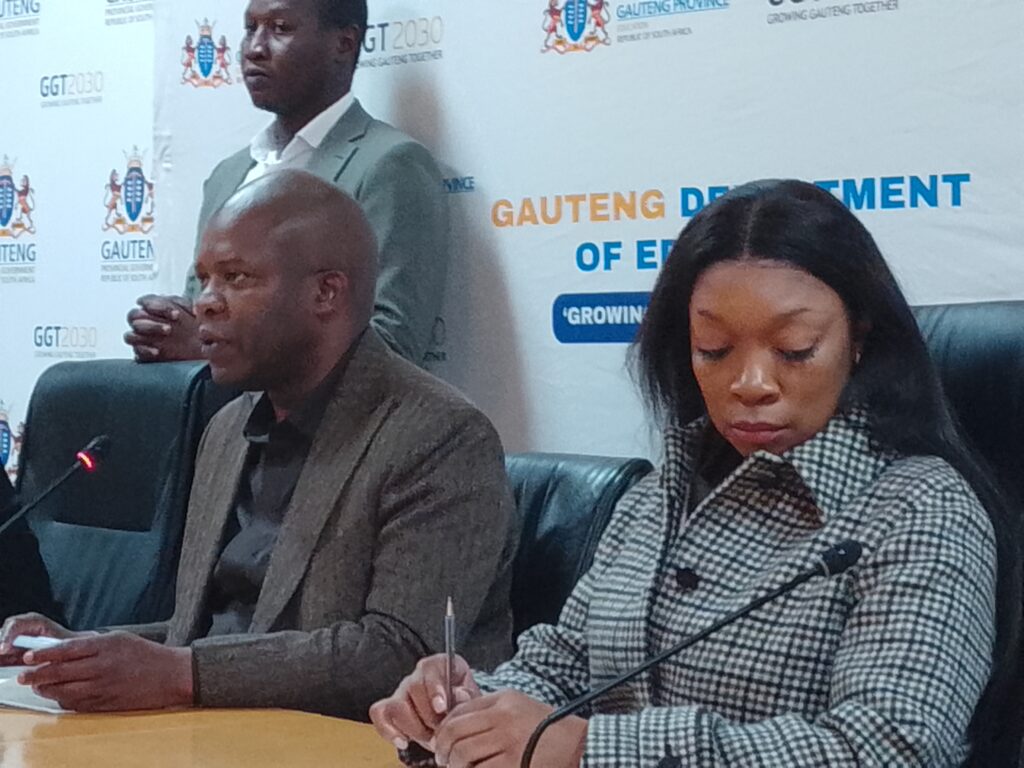
Education remains one of the most powerful tools available to transform lives, unlock opportunity and build a prosperous society. In a province carrying the aspirations of millions of young people, the Gauteng Department of Education has reaffirmed its commitment to ensuring that every learner, regardless of circumstance, has access to quality education and a fair chance at success.
The 2026/27 Budget Vote, tabled at the Gauteng Provincial Legislature, presents more than a financial plan. It offers a vision for a stronger, safer and more inclusive public education system capable of responding to the growing demands of a rapidly expanding province.
At the heart of the budget is a simple but powerful belief: it takes a village to raise a child.
The theme recognises that education cannot succeed through government efforts alone. Parents, communities, educators, civil society, business leaders and social partners all have a role to play in shaping the future of Gauteng’s children. The collective responsibility of nurturing learners remains central to the province’s long-term development agenda.
With more than 2.86 million learners enrolled across 3 320 schools, Gauteng continues to manage one of the largest education systems in South Africa. More than 2.43 million of these learners attend public schools, highlighting the immense responsibility placed on the department to provide quality education at scale.
Yet the province faces significant pressures. Rapid urbanisation, continued in-migration, overcrowded classrooms, infrastructure shortages and increasing learner demand continue to test the resilience of the education system, particularly in township communities, informal settlements and inner-city areas.
Recognising these realities, the department has increased its budget from R68 billion in the previous financial year to R70.9 billion for 2026/27. The additional R2.9 billion investment reflects a determination to strengthen educational outcomes while advancing equity, access and quality learning opportunities.
A major focus of the budget is the strengthening of Early Childhood Development, widely regarded as the foundation upon which future academic success is built. An allocation of R994 million will support the expansion of Grade R access, improve school readiness and ensure that children enter formal schooling equipped with the necessary foundational skills.
Improving learner performance remains another critical priority. The department has allocated R1.2 billion to interventions aimed at strengthening Mathematics, Science, Technology, literacy, numeracy and technical education.
These investments seek to improve educational outcomes across all phases of learning while equipping learners with the skills required in a modern economy.
Addressing infrastructure challenges also remains high on the agenda. The department has committed R2.7 billion towards infrastructure development and a broader R3.7 billion towards education modernisation initiatives. These include school reorganisation programmes, enhanced district support, leadership development for principals and the continued expansion of Schools of Specialisation.
While acknowledging that decades of infrastructure backlogs cannot be resolved overnight, the department views these investments as important steps towards reducing overcrowding and creating environments that are more conducive to teaching and learning.
Equally significant is the focus on learner wellbeing. An allocation of R3.3 billion has been directed towards school safety, psychosocial support, anti-drug initiatives, school health programmes, as well as sports, arts and cultural development. These interventions recognise that academic achievement cannot flourish in environments affected by violence, bullying, trauma, substance abuse or social instability.
Additional support comes through R3.9 billion in conditional grants, which will strengthen school nutrition programmes, infrastructure delivery, Early Childhood Development, Mathematics, Science and Technology education, HIV and AIDS Life Skills programmes, and support services for learners with profound intellectual disabilities.
The people who drive the education system remain a central priority. The department has allocated R54.6 billion towards compensation for educators, specialists, therapists and support personnel. Accounting for over 77% of the total budget, this investment underscores the critical role played by education professionals in shaping learner success and sustaining educational excellence.
Innovation and leadership development also feature prominently in the province’s strategy. Funding of R288 million has been allocated to the Sci-Bono Discovery Centre, while R383 million will support the Matthew Goniwe School of Leadership and Governance. Together, these institutions continue to strengthen science education, innovation, leadership development and educator capacity-building across Gauteng.
Ultimately, the 2026/27 Budget Vote is not merely about balancing figures on a balance sheet. It is about investing in human potential, strengthening communities and creating pathways to opportunity. It reflects a recognition that education remains the province’s most effective weapon against poverty, inequality and unemployment.
As Gauteng continues to navigate the pressures of growth and development, the message emerging from this budget is one of cautious optimism. While challenges remain, the province is positioning itself to build an education system that is more responsive, more inclusive and better equipped to prepare young people for the demands of the future.
For the millions of learners whose dreams begin in classrooms across Gauteng every day, that investment represents far more than funding. It represents hope.